My Review of Fayne by Ann-Marie MacDonald

My review: ⭐⭐⭐
Note: my review also appears on Goodreads.
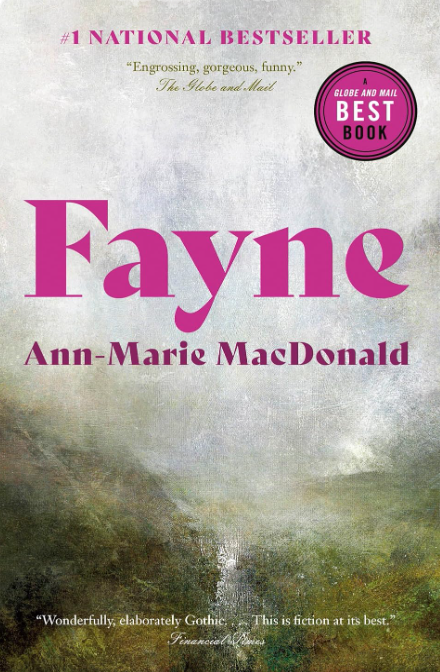
So Much Potential
This is a hard one to review. Not in the least because I feel that my opinions will be unpopular (and will place me in the minority), but because so many people loved this book, as evidenced by its relatively high average GR rating. And what wasn't to love? A quirky, plucky heroine; her coming-of-age story; strong supporting characters; the writing; the concept; the dual Victorian time periods critical to telling two intertwined stories. In essence, it is a beloved novel because it checked off many boxes that makes good historical fiction great.
After all, isn't that why I got the book myself? Wasn't one of the biggest pluses for me how many people wrote positive reviews?
Yes, and yes.
But then...
It starts out well enough. We're introduced to Charlotte, a twelve-year old precocious wildling of a girl who grows up on her family's vast estates in the borderlands between Scotland and England. She has a loving relationship with her very indulgent father, Henry, the Seventeenth Baron of the DC de Fayne. DC stands for "disputed county", and their nobility is tied to that very contestation: if a determination is ever made one way or the other, then their title and the estate's unique status will be abolished.
Henry and Charlotte live apart from others, including Henry's sister, who lives in Edinburgh, and the nearby villagers. They have a host of servants and attendants, all of whom have served Fayne and Henry's family for a very long time. They all care for and love Charlotte, whose older brother Charles died when he was two. Their mother died giving birth to Charlotte (or did she?). One of the reasons they live in isolation is because Charlotte has been told she has a mysterious "condition", making her susceptible to germs, and thus, being in poor health.
Our story starts out when Charlotte--who is quite the ambitious learner and is highly inquisitive--is told she will have a tutor. Her father, himself a studious albeit singularly-focused fellow, has taught her all he knows. He hires a tutor for her, which goes against standard mores of the time. Boys are given tutors; girls have governesses. Boys study maths, science, history, natural philosophy, and other such subjects. Girls are taught to play instruments, paint, embroider, dance, and know how to comport themselves and have suitable conversations with others.
Her tutor, Mr. Margalo, is of this mindset and is quite confused when he meets Charlotte. He even accuses Henry of making a fool of him--how could he ever hold his head high if it gets out that he's tutoring a girl? He doesn't warm up to her immediately, despite all her attempts to engage him. But over time, she breaks him down and he sees her for the brilliant mind that she is. What follows is the formation of a beautiful friendship as they learn from each other.
He even begins to tell her about university, about how some women have been getting degrees. This excites Charlotte, whose dream of late is to become a medical doctor. Mr. Margalo's teachings have opened her eyes; she's fascinated by the unseen world of microorganisms. She inhales biology and chemistry, and she knows, deep within herself, that she will be a doctor, especially if Edinburgh University will allow her to study there. Perhaps it's her medical condition, or perhaps it's because her mother died giving birth to her. Maybe both of those things contributed to her wanting to become a doctor.
I can go on and on about the plot summary. It's a very long book, and as it's a coming-of-age tale, there are very many twists and turns. Woven in with Charlotte's tale are letters written by her mother, May, to her best friend. This provides context to what happened before Charlotte was born, although Charlotte doesn't necessarily read the letters. There is also an entire section of the novel that goes back in time to tell May's side of the story. (May is an American from Boston, and thus, very unfamiliar with cultural standards in England and Scotland. When she meets Henry, both she and her father are taken by his being a Baron, despite being a poor one.)
Now, I don't mind long books. In fact, I have a specific love of doorstoppers, especially if it's historical fiction or fantasy. Michener and Rutherford do not make me nervous. I take it as me getting my money's worth. And if I can't put the book down, even better. It means I'm engaged. It means I'm loving the story. It means I'm probably going to sit and stew on this book for a very long time, highlighting passages that spoke to me, remembering characters and their idiosyncrasies, and looking things up on the side so I can learn more about the period, the history, the places, etc.
So what went wrong? Because clearly, I didn't enjoy this book as much as I wanted to.
Well, first things first: I have both the audible and kindle versions of this book.
Herein lies the first thing that frustrated me about Fayne. I was very disappointed by the author's decision to read this book herself. I think there are certain writers who can get away with this. There are also many decisions that can support an author reading their own work; after all, who better to know how to read emotions and characters than the person who wrote them? But Ann-Marie MacDonald's publishers, I hate to say, should have convinced her to go with a professional audiobook reader.
Why? A number of reasons:
First, for me, is that she is Canadian writing about Scottish/English characters. She reads the entire novel with one accent: Canadian/American. Maybe it's just me being pissy, but if I expect a majority of Scottish/English accents and I'm given American, I won't be a happy camper.
Second, Ann-Marie MacDonald did/does know her characters and how to read them. And unfortunately, that means May was at times excessively flippant and more often hysterical. She flip-flops between the two emotions with a flick of the switch. Glib one moment, then falling into histrionics the next. Her constant use of wink wink dot dot dot got very old very quickly. Needless to say, I was not amused.
And third, all of the characters sounded alike. I'm not saying she needed to do voices. But there are things professional audiobook readers can do without resorting to voicing males vs. females, such as changing timbre or pitch, having them pronounce words a certain way, having them speak faster or slower, or at a different register, etc. So yes, I think having the author read her own work, in this instance, probably did not benefit the work.
Second: I mentioned the twists and turns. Normally, this wouldn't bother me. Having dual time periods is also normally not a problem for me. Changing narrators (first person for Charlotte, third person for May) can be jarring, but again, not a big deal in the grand scheme of things. But I think all these things together muddied the waters a bit. Especially the jumping back and forth in time: part of me wondered why MacDonald didn't decide to do all of May's story as letters, or have alternating chapters told from Charlotte's and May's perspectives. If it's because May's happens in the past and Charlotte's in the present, this is not new. In fact, V.E. Schwab's Villains trilogy (Vicious, Vengeful, and the soon-to-be published Victorious) handles different narrators in both past and present very well.
Third: the main secret surrounding Charlotte and her being intersex. Yes, Victorians didn't know how to handle this "issue", and one can say even these days, some people still have trouble with it. Yes, Victorians wouldn't have the same modern sensibilities we do, nor the technology, scientific knowledge, nor the capacity to deal with the "problem" physically, mentally or emotionally. Having said that, I kept wondering if too much was made of it in the novel.
In the earlier chapters, it wasn't really a concern. Charlotte was always quirky, and having grown up in relative isolation on the moors? She being who she was really wasn't weird at all. Even later, as Charlotte, now thirteen and a young lady, is forced into learning how to act and be a lady--wearing the appropriate dresses, corsets and shoes; learning how to walk, sit, talk, and eat like a lady; learning how to embroider and pour tea; being made to give up intellectual pursuits--even the changes she underwent were normal.
But it was all the other people around her. They made the issue larger than it should've been. And no one wanted to be straight with her. No one wanted to discuss the issue or tell her the truth. Instead, they laid lies upon fabrications upon prevarications. And Charlotte, being the smart, inquisitive girl that she is, remained hopelessly gullible and innocent. I just found that hard to swallow, to believe.
Fourth: the coincidences. There were soooo many. Coincidences are double-edged swords: they can be good (such as when they spark an incident) or bad (because it's cheap and lazy, and too many writers rely on it to get their protagonists out of situations). I don't mind coincidences, provided they are used sparingly, and the aftermath of the coincidence is explained logically. Otherwise, writers can fall into the habit of having deus ex machina moments/solutions.
I don't want to go into all of the various coincidences that happened in this book; doing so will be spoilerish. And while I've included some spoilers in this review, I think listing these coincidences out will be a bridge too far.
Finally: the magical realism that runs throughout the novel. Normally, I don't mind magic or magical realism in historical fiction. That's why there's a genre such as historical fantasy.
Now, when the magic was happening on Fayne, in the moors, the bogs, within that wild, primeval, sylvan world? It was utterly normal, even expected. But then you have that weird ending. That weird ending that never seemed to end. That was a bit much. A lot of that could've been cut out. Actually, much of the last chapters probably could have been shortened or eliminated, and you still could have had an enjoyable book that didn't need to stretch the readers' suspension of disbelief.
So, like I said, I'm probably in the minority here. There was a lot that I liked about the story, particularly Charlotte's relationships with various characters: her father, her friendships with Gwen and Mr. Margalo, and her relationships with Knoxy and Old Byrn. Unfortunately, I feel there was more I didn't like, especially once I started feeling antsy because of all the twists and turns. It's never good when I start wondering "When is this going to end? This should have ended in Chapter X. That would've been a good place to end it."
View all my reviews on Goodreads here.
Comments